
 By Muhammad Irfan Liaqat
Compound Interest Explained: How Your Money Grows While You Sleep
A simple, jargon-free explanation of compound interest with real examples. See how starting early can turn small savings into serious wealth.
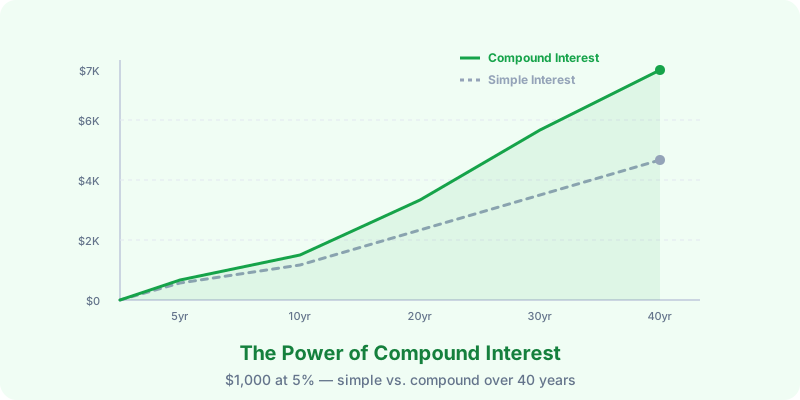
Albert Einstein allegedly called compound interest "the eighth wonder of the world." Whether he actually said that is debatable, but the point stands — compound interest is genuinely powerful, and most people don't fully appreciate how powerful until they see the numbers.
What Is Compound Interest?
Simple interest is straightforward: you earn interest on your initial deposit. If you put $1,000 in an account earning 5% per year, you get $50 every year. After 10 years, you have $1,500.
Compound interest is different. You earn interest on your initial deposit plus all the interest you've already earned. Interest earns interest. It's a snowball rolling downhill.
Same $1,000 at 5% compounded annually? After 10 years, you have $1,628.89 — not $1,500. That extra $128.89 is pure magic.
The Real Power: Time
Compound interest doesn't feel impressive in the first few years. The difference between simple and compound interest on $1,000 after 5 years is only about $27. Yawn.
But compound interest isn't a sprinter. It's a marathon runner. Watch what happens over longer periods:
| Years | Simple Interest | Compound Interest | Difference |
|---|---|---|---|
| 5 | $1,250 | $1,276 | $26 |
| 10 | $1,500 | $1,629 | $129 |
| 20 | $2,000 | $2,653 | $653 |
| 30 | $2,500 | $4,322 | $1,822 |
| 40 | $3,000 | $7,040 | $4,040 |
After 40 years, compound interest has earned you more than double what simple interest would have. And this is with just $1,000 and no additional contributions.
The $100/Month Example
Here's where it gets really interesting. Let's say you invest $100 per month at 7% annual return (close to the long-term stock market average):
After 10 years: $17,409
After 20 years: $52,397
After 30 years: $122,709
After 40 years: $264,012
You only contributed $48,000 over 40 years. The other $216,012? That's compound interest doing its thing.
Play with these numbers yourself using our Compound Interest Calculator. Adjust the monthly contribution, interest rate, and time period to see how your savings could grow.
Why Starting Early Matters (A Lot)
Meet two hypothetical savers:
Early Emma starts investing $200/month at age 25 and stops at age 35. She invested for only 10 years — a total of $24,000.
Late Larry starts investing $200/month at age 35 and continues until age 65. He invested for 30 years — a total of $72,000.
Assuming 7% annual returns, who has more at age 65?
Emma. By a long shot.
Emma's 10 years of early investing beats Larry's 30 years of later investing because her money had more time to compound. She put in $24,000 and ended up with roughly $400,000. Larry put in $72,000 — three times as much — and ended up with roughly $240,000.
That's not a typo. Starting 10 years earlier, even with fewer total contributions, won.
The Flip Side: Compound Interest on Debt
Compound interest works beautifully when it's working for you. When it's working against you — in credit card debt, for example — it's devastating.
Credit card interest rates are typically 18-25%. At 20% interest, a $5,000 balance making only minimum payments would take over 30 years to pay off, and you'd pay over $12,000 in interest.
Use our Loan EMI Calculator to understand exactly how much interest you're paying on any loan, and consider the Percentage Calculator to work out how much of your payment goes to interest vs. principal.
How to Take Advantage
1. Start now. The best time was 10 years ago. The second best time is today.
2. Be consistent. Regular contributions matter more than the amount.
3. Don't withdraw early. Every dollar you take out is a dollar that stops compounding.
4. Increase contributions over time. As your income grows, put a portion of every raise into savings.
5. Minimize fees. A 1% management fee might not sound like much, but over 30 years it can eat a significant chunk of your returns.
Compound interest doesn't require luck, skill, or market timing. It just requires patience. And that's exactly what makes it so powerful — anyone can do it.