
 By
How Loan Interest Is Calculated, Month by Month
Follow a 20,000 loan month by month to see how interest is charged, why a flat rate costs almost twice as much, and what fees and extra payments really do.
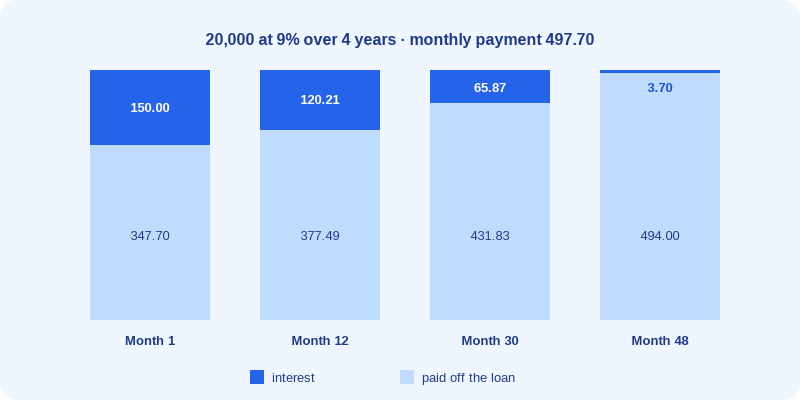
A loan offer shows you two numbers: the rate and the monthly payment. What it doesn't show is how the interest is actually charged, which is where two loans with the same headline rate can end up costing very different amounts.
The easiest way to understand it is to follow one loan through its whole life. We'll use a personal loan of 20,000 at 9% a year, repaid monthly over 4 years. The currency doesn't matter; the arithmetic works the same in dollars, pounds, rupees or riyals.
The Monthly Payment
For a standard loan with equal monthly payments, the payment comes from a formula that uses three inputs: the amount borrowed, the monthly interest rate (9% ÷ 12 = 0.75%) and the number of payments (48). For our loan it gives:
Monthly payment: 497.70
Over 48 months that's 23,889.64 in total, so the loan costs 3,889.64 in interest. If you want to see the formula worked through step by step, our EMI calculation guide does exactly that. Here we're more interested in what happens inside each payment.
Month One, by Hand
Each month the lender does two things:
- Charges interest on what you still owe. In month one you owe the full 20,000. One month's interest at 0.75% is 20,000 × 0.0075 = 150.00.
- Uses the rest of your payment to cut the balance. 497.70 − 150.00 = 347.70 goes to the loan itself. You now owe 19,652.30.
Month two repeats the process on the smaller balance: 19,652.30 × 0.0075 = 147.39 in interest, and 350.31 off the balance.
That's the whole mechanism. Interest is only ever charged on the balance you still owe, so as the balance falls, the interest part of each payment shrinks and the repayment part grows.
| Month | Payment | Interest | Paid off the loan | Balance left |
|---|---|---|---|---|
| 1 | 497.70 | 150.00 | 347.70 | 19,652.30 |
| 2 | 497.70 | 147.39 | 350.31 | 19,301.99 |
| 3 | 497.70 | 144.76 | 352.94 | 18,949.05 |
| ... | ... | ... | ... | ... |
| 48 | 497.70 | 3.70 | 494.00 | 0.00 |
A table like this is called an amortisation schedule. Your lender can give you yours, and it's worth asking for.
Year by Year
Add the months up and the pattern is clear:
| Year | Interest paid | Paid off the loan |
|---|---|---|
| 1 | 1,623.51 | 4,348.90 |
| 2 | 1,215.56 | 4,756.86 |
| 3 | 769.33 | 5,203.08 |
| 4 | 281.24 | 5,691.17 |
Over 40% of all the interest is paid in the first year. This matters if you're thinking of paying the loan off early: settling after year two saves the interest of years three and four, but you've already paid most of the interest the loan was ever going to cost.
Flat Rate vs Reducing Balance: The Trap
Everything above uses the reducing balance method, where interest is charged on what you still owe. Some lenders, most often for car loans and consumer finance, quote a flat rate instead. A flat rate charges interest on the original amount for the whole term, even as you pay it down.
Same 20,000, same "9%", same 4 years:
| Method | Total interest | Monthly payment |
|---|---|---|
| 9% reducing balance | 3,889.64 | 497.70 |
| 9% flat | 7,200.00 | 566.67 |
The flat-rate loan costs 7,200 in interest (20,000 × 9% × 4 years), almost twice as much. To match its monthly payment, a reducing-balance loan would need a rate of about 16%. Put the other way, a 9% reducing-balance loan is equivalent to a flat rate of under 5%.
So when you compare offers, always ask: "Is that a flat rate or a reducing-balance rate?" and compare the total amount repaid, not the rate on the brochure.
Fees Change the Real Rate
Many loans charge an arrangement or processing fee, sometimes added to the loan and sometimes taken out of the money you receive.
Say the lender charges a 2% fee of 400 and deducts it, so 19,600 reaches your account while you still repay 497.70 a month on 20,000. The effective rate on the money you actually received is about 10.06%, not 9%. This is the idea behind the APR (annual percentage rate) or "effective rate" that lenders in many countries must show alongside the headline rate: it folds fees into one comparable number. The exact rules for calculating it vary by country, so compare APRs from the same market.
How Rate and Term Change the Cost
For the same 20,000 over 4 years:
| Annual rate | Monthly payment | Total interest |
|---|---|---|
| 6% | 469.70 | 2,545.63 |
| 9% | 497.70 | 3,889.64 |
| 12% | 526.68 | 5,280.48 |
| 15% | 556.61 | 6,717.52 |
| 18% | 587.50 | 8,200.00 |
And at 9%, for different terms:
| Term | Monthly payment | Total interest |
|---|---|---|
| 3 years | 635.99 | 2,895.81 |
| 4 years | 497.70 | 3,889.64 |
| 5 years | 415.17 | 4,910.03 |
| 6 years | 360.51 | 5,956.77 |
Stretching from 4 to 6 years cuts the payment by about 137 a month, but adds about 2,067 in interest. A lower monthly payment is not the same as a cheaper loan.
What Extra Payments Do
Because interest is charged on the balance, anything that lowers the balance early saves interest on every month that follows.
Add 100 a month to our loan, applied to the balance, and it's cleared in 39 payments instead of 48, the last one smaller than the rest. Total interest drops from 3,889.64 to 3,115.37, a saving of 774.27.
Before you do this, check two things with your lender: that extra payments go to the principal rather than being held as "advance payments", and whether there's an early repayment charge.
Questions to Ask Before You Sign
- Is the rate flat or reducing balance?
- What is the APR or effective rate, including all fees?
- What is the total amount I will repay?
- Can I make extra payments, and are they applied to the balance?
- Is there a charge for paying the loan off early?
- Is the rate fixed for the whole term, or can it change?
Run Your Own Numbers
The Loan EMI Calculator shows the monthly payment, total interest, total payment and the split between principal and interest for any amount, rate and term in years. It uses the reducing-balance method described here and runs in your browser. To check a percentage or a fee, the Percentage Calculator does it in one step.
Frequently Asked Questions
How is interest calculated on a loan each month?
For a standard reducing-balance loan, the lender multiplies the balance you still owe by the monthly rate (the annual rate divided by 12). On 20,000 at 9% a year, the first month's interest is 20,000 × 0.75% = 150. The rest of your payment reduces the balance.
What is the monthly payment on a 20,000 loan at 9% for 4 years?
497.70 a month, with 3,889.64 in total interest, for a standard reducing-balance loan with monthly payments.
Is a flat interest rate the same as a reducing rate?
No. A flat rate charges interest on the original loan amount for the whole term, so it costs much more. A 9% flat rate over 4 years costs about the same as a 16% reducing-balance rate.
Do extra payments reduce the interest on a loan?
Yes, if the lender applies them to the balance. Paying an extra 100 a month on a 20,000 loan at 9% over 4 years clears it 9 months early and saves 774.27 in interest.
Results are estimates for general information, not financial advice. Real loans and investments can include fees, taxes and terms not modelled here. Read the disclaimer.