
 By Muhammad Irfan Liaqat
How to Count Days Between Two Dates
Calculate the number of days between two dates or add and subtract days from any date. Covers business days, date math tricks, and common deadline calculations.
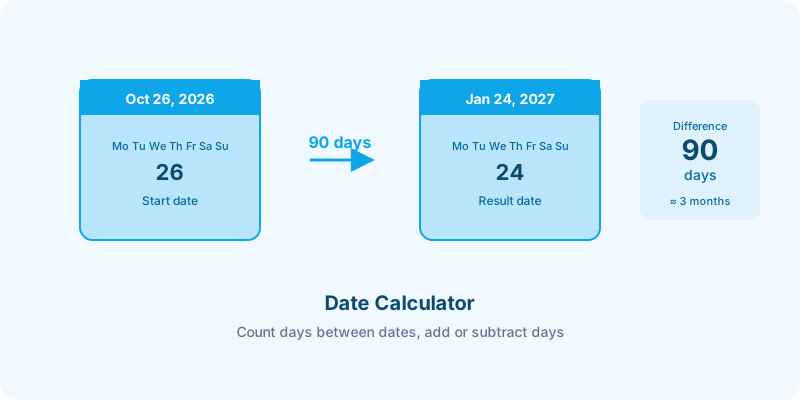
Someone tells you a deadline is "90 days from now." Your brain immediately tries to count months on its knuckles. February is in there somewhere, which means... actually, you have no idea. This is why date calculators exist.
Days Between Two Dates
The most common date calculation is simple: how many days between Date A and Date B?
You'd think you could do this in your head. And sometimes you can — "December 20 to December 25 is 5 days" is easy. But what about "October 26, 2026 to March 15, 2027?" Now you're juggling months with 28, 30, and 31 days, crossing a year boundary, and hoping you don't forget February.
Our Date Difference Calculator handles this in seconds. Enter two dates and get the exact difference in years, months, and days — plus the total number of days.
Why the calculation is trickier than it seems
Month lengths vary (28, 29, 30, or 31 days), years have either 365 or 366 days, and the rules for leap years aren't as simple as "every four years." Years divisible by 100 are not leap years, unless they're also divisible by 400. So 2000 was a leap year, but 1900 wasn't, and 2100 won't be.
For everyday calculations this rarely matters, but for contracts, legal deadlines, and financial instruments spanning decades, getting the leap year logic right is essential.
Adding or Subtracting Days from a Date
The second most common calculation: "What date is 90 days from today?" or "What was the date 30 days ago?"
This comes up in:
- Legal deadlines: "You have 60 days to respond."
- Contracts: "Payment is due 30 days after invoice date."
- Medical instructions: "Follow up in 14 days."
- Project planning: "We launch in 45 days."
- Warranties: "Valid for 365 days from purchase."
Our Add or Subtract Days tool handles this. Enter a starting date, add or subtract a number of days (or weeks, or months), and get the resulting date.
Common day-count calculations
Here are the ones people search for most often:
| Calculation | From Oct 26, 2026 |
|---|---|
| 30 days from today | November 25, 2026 |
| 60 days from today | December 25, 2026 |
| 90 days from today | January 24, 2027 |
| 180 days from today | April 24, 2027 |
| 30 days ago | September 26, 2026 |
We also have pre-calculated pages for the most popular lookups: 30 days from today, 60 days from today, 90 days from today, and 90 days ago. These update automatically based on today's date.
Business Days vs. Calendar Days
This distinction trips people up all the time, especially with legal and financial deadlines.
Calendar days count every day — weekdays, weekends, holidays, all of them. "30 calendar days" is exactly 30 days on the calendar.
Business days (also called working days) skip weekends and usually skip public holidays. "30 business days" is typically about 6 weeks (42 calendar days).
When a contract or government notice says "days," you need to know which kind they mean. Government agencies usually specify. If they don't, "calendar days" is typically the default in legal contexts.
Date Math Gotchas
Adding months isn't always reversible
January 31 plus one month is February 28 (or 29 in a leap year). But February 28 plus one month is March 28 — not March 31. Adding a month and then subtracting a month doesn't always get you back to where you started.
The end-of-month problem
If a recurring event happens on the 31st, what happens in months with 30 days? Or February? Most systems "snap" to the last day of the shorter month. Your "31st of every month" payment might hit on the 28th in February.
Time zones and date boundaries
If a deadline is "October 31" and you're in California, you have until 11:59 PM Pacific Time — not midnight in New York or London. For international contracts, the time zone (or "close of business" in a specific city) should be specified.
Practical Date Calculation Examples
Passport renewal: Many countries require your passport to be valid for at least 6 months beyond your travel dates. If your trip is on June 15, your passport needs to be valid until at least December 15.
90-day visa: Entered a country on January 10? Adding 90 days takes you to April 10 in a non-leap year. Many countries count your entry day as day one, which makes April 9 your last day, so check the rule for your visa. Use our Date Difference Calculator to keep track.
Tax deadlines: If the tax filing deadline is April 15 and you file an extension, you typically get an extra 6 months — making it October 15.
Pregnancy due dates: 280 days (40 weeks) from the first day of the last menstrual period. Doctors use this calculation every day.
Lease agreements: A 12-month lease starting November 1 runs through October 31 of the next year. Count the days with our Date Difference Calculator to verify.
The Quick Way
For any date calculation, our tools run entirely in your browser — no data is sent anywhere, and they handle all the leap year and month-length edge cases automatically.
- [Date Difference Calculator](/tools/date-difference) — Find the exact time between any two dates
- [Add or Subtract Days](/tools/add-subtract-days) — Jump forward or backward from any date
- [Countdown Timer](/tools/countdown-timer) — See a live countdown to any future date
- [Days From Today](/days-from-today/30) — Pre-calculated answers for common lookups