
 By Muhammad Irfan Liaqat
How to Work Out Discounts and Sale Prices
Learn how to calculate discounts, find sale prices, and compare deals. Covers stacking discounts, unit pricing, and common retail math traps to avoid.
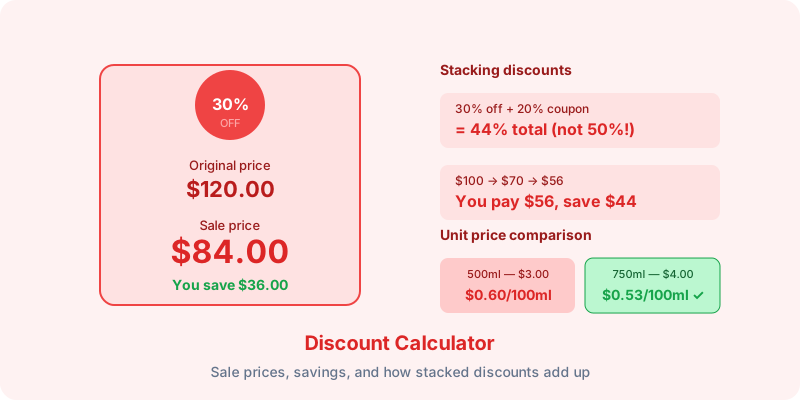
"50% off everything!" screams the banner. Your brain says "half price." Your wallet says "proceed with caution." The wallet is usually right, and a few simple formulas show you why.
The Basic Discount Calculation
Every discount calculation follows the same formula:
Sale price = Original price × (1 − Discount percentage ÷ 100)
Or more intuitively: find the discount amount, then subtract it from the original price.
A $80 item at 25% off:
- Discount amount: $80 × 0.25 = $20
- Sale price: $80 − $20 = $60
Our Discount Calculator does this instantly — enter the original price and discount percentage, and it shows you the sale price and how much you save.
Reverse Discount: Finding the Percentage
Sometimes you know the sale price but not the discount percentage. A jacket was $120 and is now $84 — what percentage off is that?
Discount % = (Original price − Sale price) ÷ Original price × 100
($120 − $84) ÷ $120 × 100 = 30% off
This is useful when stores show a sale price without stating the discount, or when comparing deals across different retailers.
Stacking Discounts: The Math That Tricks Everyone
Here's where most people get caught. A store offers 30% off, and you have a coupon for an additional 20% off. That's 50% off total, right?
Wrong.
The discounts stack multiplicatively, not additively:
- Original price: $100
- After 30% off: $100 × 0.70 = $70
- After additional 20% off: $70 × 0.80 = $56
The actual total discount is 44%, not 50%. You save $44 instead of $50. The order doesn't matter — 20% off then 30% off gives the same $56 — but the combined discount is always less than the sum of the individual discounts.
Why it works this way: The second discount applies to the already-reduced price, not the original. Each discount shrinks the base that the next discount operates on.
"Up to X% Off" — What It Really Means
When a store advertises "up to 70% off," they're telling you the maximum discount on any single item. Here's the reality:
- A few items are 70% off (usually leftover stock they're trying to clear)
- Many items are 20–40% off
- Some items aren't discounted at all but are in the same section
Always check the actual discount on the specific item you want rather than assuming the headline number applies to everything.
Unit Price: The Real Deal Detector
Discounts on bulk items are meaningless without unit pricing. A "buy 2 get 1 free" deal on something you'll never use twice isn't a deal — it's spending more money.
Unit price = Total price ÷ Quantity or weight
- 500ml bottle for $3.00 → $0.60 per 100ml
- 750ml bottle for $4.00 → $0.53 per 100ml
The bigger bottle is cheaper per unit. But the small bottle costs less overall, and if the product expires before you finish the large one, the "savings" become waste.
Once you have both unit prices, the percentage change mode in our Percentage Calculator tells you how much cheaper one is: here, $0.60 to $0.53 per 100ml is about 11% less.
Common Retail Math Traps
The anchor price trick. "Was $200, now $99!" — but was it ever actually sold at $200? Some retailers inflate the "original" price to make the discount look bigger. Check price history tools or competing retailers.
Minimum spend thresholds. "Spend $75, get $15 off." If you were only going to spend $50, you're now spending an extra $25 to save $15 — a net loss of $10. Only worth it if you needed $75+ of stuff anyway.
Percentage off vs. dollar off. "20% off" on a $30 item saves $6. "$10 off orders over $50" saves $10 if you spend $50. Neither is inherently better — do the specific math for your purchase.
BOGO confusion. "Buy one, get one 50% off" is not 50% off. On two $40 items, you pay $40 + $20 = $60 for $80 worth of product. That's 25% off overall, not 50%.
Sale Shopping Strategy
- Know the price before the sale. Track prices on items you actually want, so you recognize a real deal versus a fake "original" price.
- Calculate per-item or per-unit cost. Especially for bundles and bulk deals.
- Set a budget before browsing. Saving 40% on something you didn't need is still spending money.
- Stack strategically. Apply coupons, loyalty points, and sale prices in the order that maximizes savings. Some stores let you combine; others don't.
The Quick Way
Our Discount Calculator shows the sale price and how much you save as soon as you enter the original price and discount. It works on one discount at a time, so for a stacked deal, run it again with the first sale price as the new original price. For comparing unit prices or working out a discount from a before-and-after price, the Percentage Calculator has you covered.