
 By Muhammad Irfan Liaqat
How to Calculate Percentages: The Complete Guide
Learn how to calculate percentages the easy way. Covers percentage of a number, percentage change, percentage difference, and tips you can use every day.
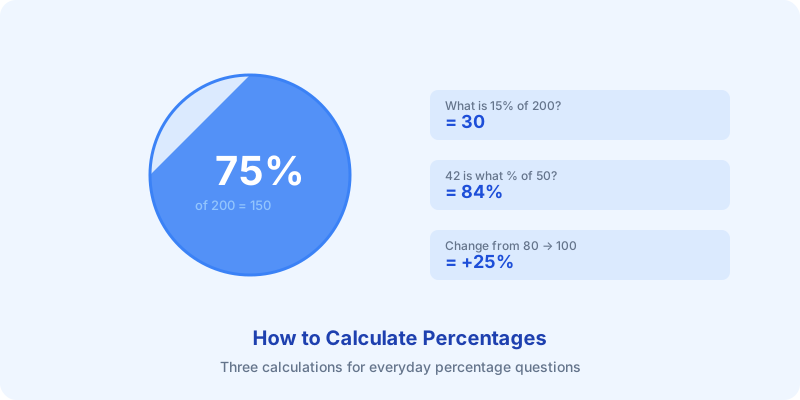
Percentages show up everywhere: sales tax, tips, exam scores, discounts, interest rates, nutritional labels, battery levels. Most of us learned the formulas in school and promptly forgot them. Here they are again, with examples you'll actually use.
What Is a Percentage?
A percentage is a number out of 100. The word itself comes from the Latin "per centum," meaning "by the hundred." When you say 25%, you mean 25 out of every 100.
That's it. Every percentage calculation is just some variation of dividing, multiplying, or comparing numbers against 100.
The Three Calculations You'll Actually Use
Almost every real-world percentage problem falls into one of three categories. Learn these three and you can handle nearly anything.
1. What Is X% of Y?
This is the most common one. "What's 15% of 200?" or "How much is 8.5% sales tax on a $75 purchase?"
The formula: Multiply the number by the percentage, then divide by 100.
15% of 200 = 200 × 15 ÷ 100 = 30
Shortcut: Move the decimal point two places left. 15% becomes 0.15. Then multiply: 200 × 0.15 = 30.
Real-world examples:
- Sales tax: A $75 item with 8.5% tax → 75 × 0.085 = $6.38 in tax
- Tips: 20% tip on a $48 meal → 48 × 0.20 = $9.60
- Discounts: 30% off a $120 jacket → 120 × 0.30 = $36 saved
Our Percentage Calculator handles all of these instantly — type in two numbers and get your answer.
2. What Percentage Is X of Y?
This one answers "I scored 42 out of 50 on the test — what's my percentage?" or "I've saved $3,400 of my $10,000 goal — how far along am I?"
The formula: Divide the part by the total, then multiply by 100.
42 ÷ 50 × 100 = 84%
More examples:
- Exam score: 78 out of 90 → 78 ÷ 90 × 100 = 86.7%
- Savings goal: $3,400 of $10,000 → 3,400 ÷ 10,000 × 100 = 34%
- Project progress: 7 of 12 tasks done → 7 ÷ 12 × 100 = 58.3%
3. Percentage Change (Increase or Decrease)
This answers "Gas was $3.20 last month and $3.50 now — by what percentage did it go up?" or "My website traffic dropped from 5,000 to 4,200 visits — what's the decline?"
The formula: Subtract the old value from the new value, divide by the old value, and multiply by 100.
(3.50 - 3.20) ÷ 3.20 × 100 = 9.4% increase
If the result is negative, it's a decrease:
(4,200 - 5,000) ÷ 5,000 × 100 = -16% (a 16% decrease)
This is probably the most useful calculation for anyone tracking finances, business metrics, or performance over time. Our Percentage Calculator has a dedicated percentage change mode that handles the math for you.
Percentage Difference vs. Percentage Change
People confuse these constantly, so let's be clear.
Percentage change measures how much something increased or decreased from an original value. It has a direction — up or down.
Percentage difference measures how far apart two values are, without caring which came first. It uses the average of both values as the base.
Example: Comparing prices of $40 and $50.
- Percentage change (from $40 to $50): (50-40) ÷ 40 × 100 = 25% increase
- Percentage change (from $50 to $40): (40-50) ÷ 50 × 100 = 20% decrease
- Percentage difference: (50-40) ÷ ((50+40)÷2) × 100 = 22.2% difference
Notice the percentage change depends on direction, but percentage difference doesn't. Use percentage change when comparing a before and after. Use percentage difference when comparing two independent values, like competing prices or test scores from different groups.
Mental Math Tricks for Percentages
You don't always need a calculator. Here are shortcuts that work in your head.
10% of anything: Move the decimal one place left. 10% of 85 = 8.5. 10% of 2,340 = 234.
5% of anything: Find 10%, then halve it. 5% of 85 = 4.25.
20% of anything: Find 10%, then double it. 20% of 85 = 17.
15% (for tips): Find 10%, then add half of that. 15% of 60 = 6 + 3 = 9.
25% of anything: Divide by 4. 25% of 80 = 20.
1% of anything: Move the decimal two places left. 1% of 4,500 = 45.
You can combine these for any percentage. Need 35%? That's 25% + 10%. Need 12%? That's 10% + 1% + 1%.
Common Percentage Mistakes
Mistake: Adding percentages that shouldn't be added. A 40% discount followed by another 20% discount is not 60% off. The second discount applies to the already-reduced price. A $100 item at 40% off becomes $60. Then 20% off $60 is $12 — so you pay $48, which is 52% off, not 60%.
Mistake: Reversing percentage change. If a stock drops 50%, it needs to go up 100% to get back to its original price — not 50%. Going from $100 to $50 is a 50% drop. Going from $50 back to $100 is a 100% increase.
Mistake: Confusing percentage points with percentages. If unemployment goes from 4% to 5%, that's a 1 percentage point increase, but a 25% increase. News headlines mix these up constantly.
When the Math Gets Annoying
For quick calculations, the mental math tricks above work well. When you need precision, with awkward numbers or an effective tax rate to two decimal places, use our Percentage Calculator. It puts all three calculation types on one page, so you can type in your numbers and read the answer. For savings that grow over time, the Compound Interest Calculator is the better fit.
For shopping-specific calculations, the Discount Calculator shows the sale price and how much you save. For stacked discounts, run it twice, using the first sale price as the new starting price. The Tip Calculator handles percentage-based tips with bill splitting built in.