
 By Muhammad Irfan Liaqat
Metric vs Imperial: A Unit Conversion Guide
Convert between metric and imperial units for length, weight, temperature, and more. Quick reference tables, mental math tricks, and a free converter tool.
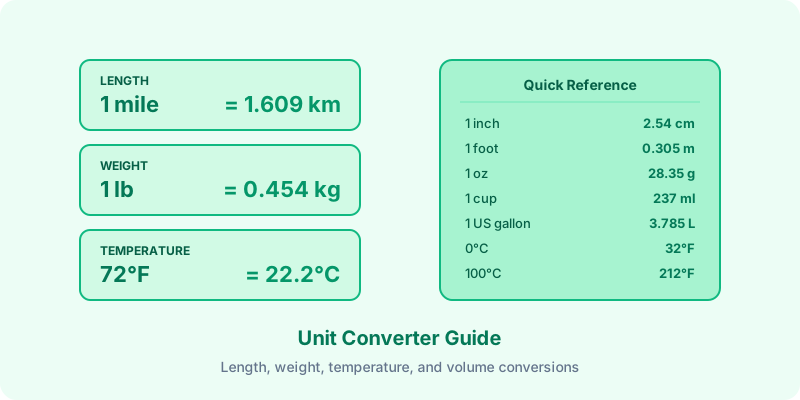
The US uses miles, pounds, and Fahrenheit. The rest of the world uses kilometers, kilograms, and Celsius. Recipes call for cups and ounces or milliliters and grams, depending on which side of the Atlantic they came from. It's a mess, and sooner or later everyone has to convert between the two.
Why Two Systems Exist
The metric system (formally the International System of Units, or SI) is based on powers of 10. A kilometer is 1,000 meters. A kilogram is 1,000 grams. Clean and logical.
The imperial system (and its close cousin, US customary units) grew from historical measurements — the length of a king's foot, the weight of a grain of barley, the temperature at which brine freezes. Not logical, but deeply entrenched in the US, UK (partially), and a handful of other countries.
Neither is going away anytime soon, so let's learn to convert between them.
Length Conversions
Length is the most frequently needed conversion, especially for travelers and anyone reading international content.
Key relationships
| From | To | Multiply by |
|---|---|---|
| Inches | Centimeters | 2.54 |
| Feet | Meters | 0.3048 |
| Yards | Meters | 0.9144 |
| Miles | Kilometers | 1.609 |
| Centimeters | Inches | 0.3937 |
| Meters | Feet | 3.281 |
| Kilometers | Miles | 0.6214 |
Mental math shortcuts
- Miles to km: Multiply by 1.6, or add 60%. 10 miles ≈ 16 km.
- Km to miles: Multiply by 0.6, or subtract 40%. 10 km ≈ 6 miles.
- Feet to meters: Divide by 3.3. 6 feet ≈ 1.8 meters.
- Inches to cm: Multiply by 2.5 (close enough for rough estimates). 4 inches ≈ 10 cm.
Fun fact: the Fibonacci sequence approximates miles-to-kilometers. 5 miles ≈ 8 km, 8 miles ≈ 13 km, 13 miles ≈ 21 km. Each number is roughly 1.6× the previous one.
Weight Conversions
Weight conversions matter for cooking, shipping, fitness tracking, and medical dosages.
Key relationships
| From | To | Multiply by |
|---|---|---|
| Ounces | Grams | 28.35 |
| Pounds | Kilograms | 0.4536 |
| Kilograms | Pounds | 2.205 |
| Grams | Ounces | 0.03527 |
Mental math shortcuts
- Pounds to kg: Divide by 2.2, or roughly halve and subtract 10%. 150 lbs ≈ 68 kg.
- Kg to pounds: Multiply by 2.2, or double and add 10%. 70 kg ≈ 154 lbs.
- Ounces to grams: Multiply by 28. 4 oz ≈ 112 g.
Temperature Conversions
Temperature is the conversion that confuses people most, because the relationship isn't a simple multiplication.
The formulas
- °F to °C: (°F − 32) × 5/9
- °C to °F: (°C × 9/5) + 32
Common reference points
| °C | °F | What it means |
|---|---|---|
| 0 | 32 | Water freezes |
| 10 | 50 | Cool day, jacket weather |
| 20 | 68 | Comfortable room temperature |
| 30 | 86 | Hot summer day |
| 37 | 98.6 | Human body temperature |
| 40 | 104 | Heat wave / fever |
| 100 | 212 | Water boils |
Mental math shortcut
For a rough Fahrenheit-to-Celsius conversion: subtract 30, then divide by 2.
72°F → (72 − 30) ÷ 2 = 21°C (actual: 22.2°C — close enough for weather)
For Celsius to Fahrenheit: double it and add 30.
25°C → (25 × 2) + 30 = 80°F (actual: 77°F — good enough for planning what to wear)
Volume Conversions
Volume gets especially tricky because both metric and imperial have multiple units in common use.
Cooking conversions
| From | To | Amount |
|---|---|---|
| 1 cup | Milliliters | 237 ml |
| 1 tablespoon | Milliliters | 15 ml |
| 1 teaspoon | Milliliters | 5 ml |
| 1 fluid ounce | Milliliters | 30 ml |
| 1 liter | Cups | 4.23 cups |
| 1 US gallon | Liters | 3.785 L |
Quick rule for cooking: 1 cup ≈ 240 ml, 1 tablespoon ≈ 15 ml, 1 teaspoon ≈ 5 ml. These round numbers are close enough for any recipe.
When Precision Matters
For everyday use — cooking, travel, fitness — approximate conversions are fine. Nobody cares if their road trip is 161 km or 160.9 km.
But some fields require exact conversions:
- Engineering and construction: Tolerances measured in thousandths of an inch
- Medicine: Dosages calculated in milligrams per kilogram of body weight
- Science: Measurements that must be reproducible
- International trade: Shipping weights and dimensions on customs forms
For these cases, use a precise converter rather than mental math. Our Unit Converter handles length, weight, temperature, volume, and more with full precision.
The Quick Way
Stop googling "72 kg to lbs" every time. Our Unit Converter converts between all common units instantly — length, weight, temperature, volume, area, speed, and data storage. It runs entirely in your browser and works on any device. Type a number, pick your units, and get the answer.